An AI assistant on your website: what does it do for a small business?
Answering at night, sorting requests, freeing up the phone: what an AI assistant really changes for a shop or a tradesperson.
Local model or a major provider's API: where your customers' messages go, what the GDPR says, model training, and how to choose a provider.
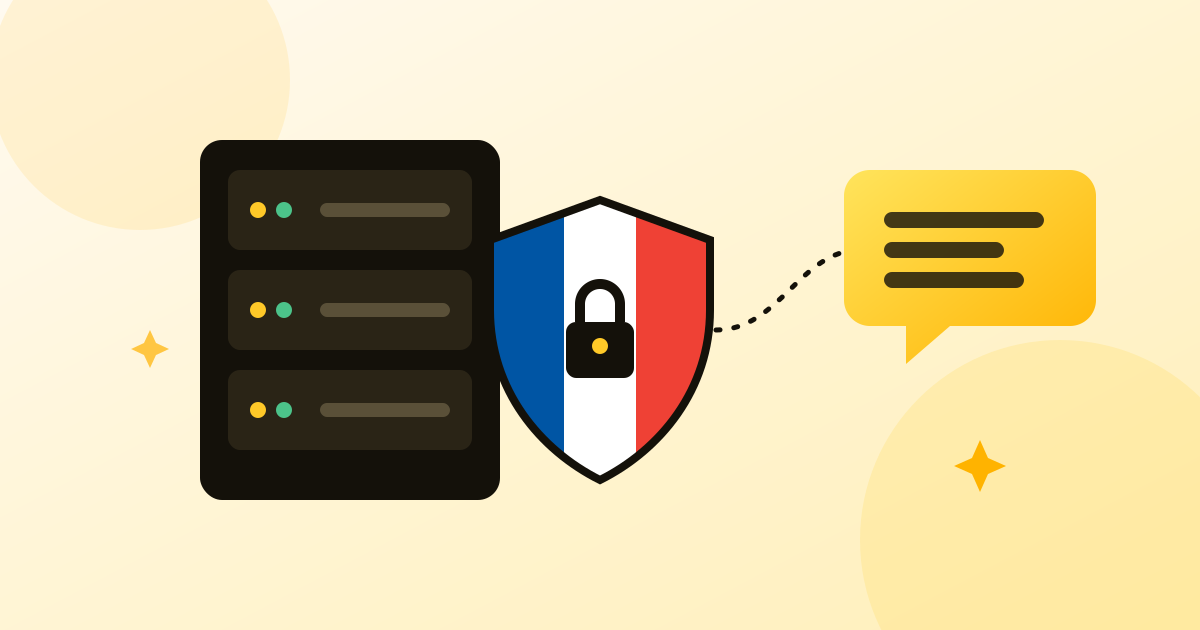
When a visitor writes to the assistant on your website, they sometimes share much more than a question: their name, address, phone number, sometimes a personal detail. These messages are personal data, and you are responsible for them. So “where are they processed?” is not just a technical detail.
Most AI assistants do not run the model themselves: they send each message to a large model provider, often based in the United States, then display its answer. In practice, a single conversation can pass through:
This is not illegal, but each step must be covered by proper safeguards, and you must be able to explain it to your customers.
A “local” model is an open AI model that the tool installs on its own servers. Messages do not leave that machine, which makes the question of transfers simpler. On the other hand, the models that fit on an affordable server are smaller: their answers are often less reliable, slower, and they follow precise instructions such as “say you do not know rather than make something up” less well.
A major provider's API gives access to much more capable models, which are fast and better at following your rules. On the other hand, the messages needed for the answer are sent to that provider, often outside the European Union. You then need to check its terms: use of the data, retention period, transfer safeguards. A US company is also subject to US law, for example the CLOUD Act.
Neither approach is perfect. What matters is that your provider tells you clearly which one it uses, and what happens to the messages.
The General Data Protection Regulation applies as soon as you process the data of people in the European Union, including, in many cases, when your business is based outside the EU but serves customers there. For a chatbot, three points matter most:
The CNIL, the French data protection authority, publishes guidance on AI and personal data: it is a good basis for checking any tool.
Another point is often overlooked: some services may use conversations to improve their models, depending on the plan and the settings chosen. Your customers' messages could then help train another company's AI. Always read the terms: the wording should be clear and, ideally, this use should be excluded by default. This is often the case for business API plans, unlike some consumer apps.
We first tried a local model on our servers. For the quality and reliability of the answers, Flopia now relies on Claude, Anthropic's AI model, known for its reliability. In practice:
Details are in our privacy policy.
Before installing a chatbot, whichever one it is, ask:
A serious provider answers these six questions without hesitation. If the answers are vague, that is already an answer.
Sources: text of the GDPR on EUR-Lex; CNIL resources on AI; Anthropic's commercial terms; Anthropic's privacy policy. Article updated on 14 October 2026. This article is for information only and does not constitute legal advice.
Answering at night, sorting requests, freeing up the phone: what an AI assistant really changes for a shop or a tradesperson.
Since 2 August 2026, the AI Act's transparency obligations apply. Here is what that changes for the chatbot on your website.
Wrong opening hours, invented prices, impossible promises: why a chatbot sometimes makes things up, and 6 settings to keep it reliable.